HEROES – Higher Education for Resilience-Oriented and Empowered Societies – is a European Universities Alliance bringing together nine practice-oriented higher education institutions from nine countries. Its community comprises approximately 120,000 students and 14,000 staff members. Together, the partners explore how education, applied research and regional collaboration can strengthen the resilience of individuals, organisations and communities.
On 28 October 2026, the online HEROES State-of-the-Art Event with Alliance STE(A)M Teams brought together colleagues working in STE(A)M education, teacher education, engineering and technology. The event was organised as part of the community engagement initiatives under HEROES Work Package 7, Ecosystem and Community. Its aim was not to identify a single STE(A)M model suitable for all institutions, but rather to explore existing practices across the Alliance’s higher education institutions and identify opportunities for combining the partners’ expertise.
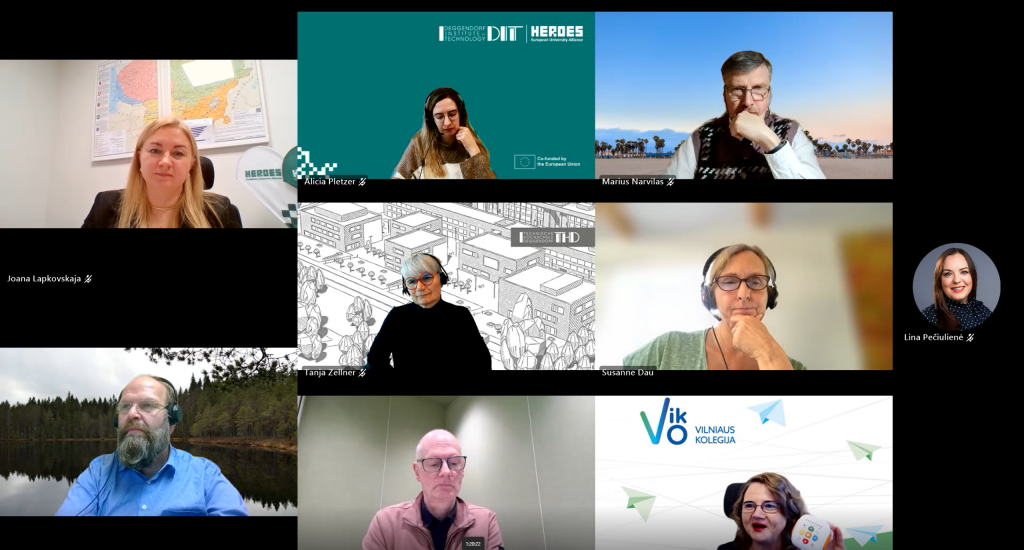
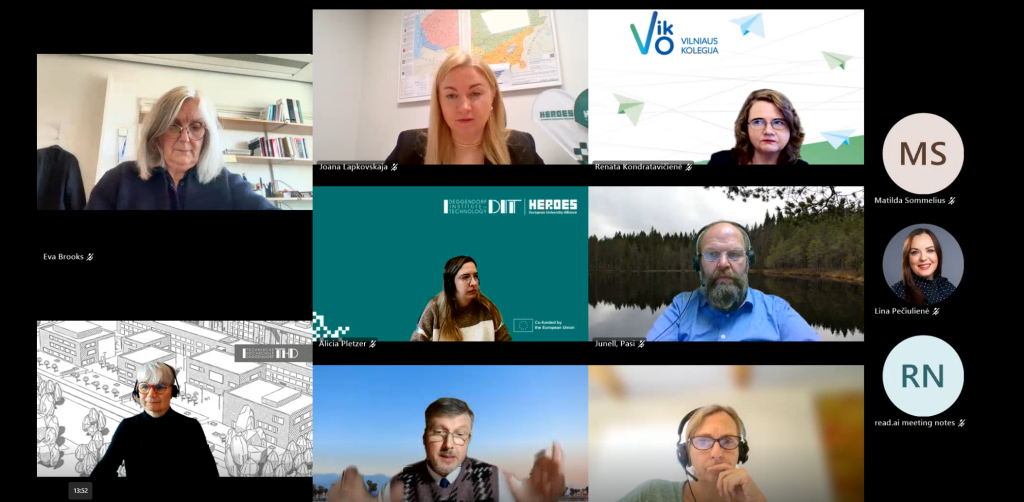
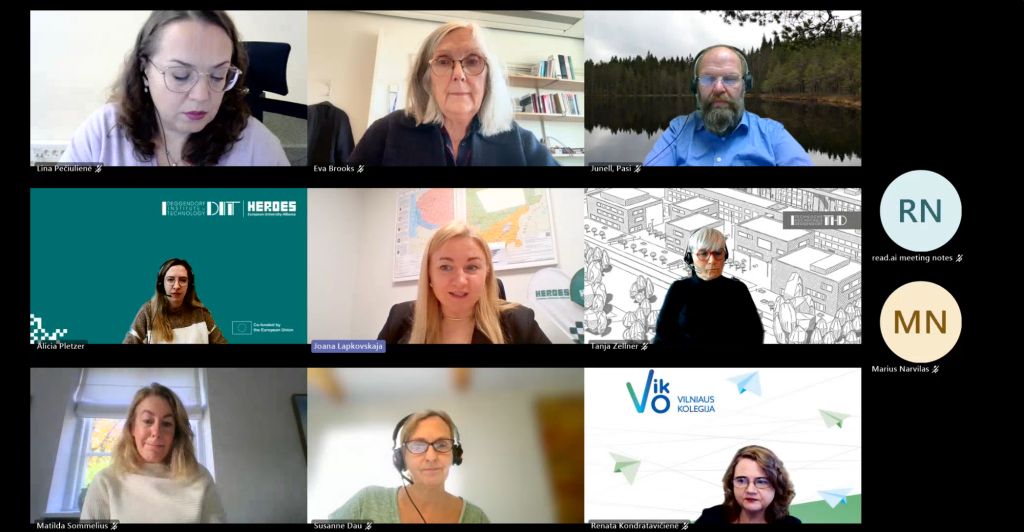
The meeting opened with introductory remarks by Alicia Pletzer, HEROES WP7 Leader from the Deggendorf Institute of Technology; Joana Lapkovskaja, Head of the Public and Community Services Office at VIKO and VIKO’s HEROES WP7 representative; and Associate Professor Dr Renata Kondratavičienė, Head of the Studies Department at VIKO’s Faculty of Pedagogy. Their opening remarks set the direction for the day: it was important for partners not only to showcase their activities but also to listen to one another, identify shared interests and explore topics that could develop into joint projects.
Marius Narvilas, Head of the Engineering Laboratory at Vilnius University’s STEAM Education Methodological Centre, presented a broader perspective on STE(A)M approaches, challenges and future prospects. His presentation placed particular emphasis on learning by doing through construction, experimentation, data collection and the refinement of solutions. In such activities, the final product is not the only important outcome. Equally valuable is what learners do when their initial idea does not work – how they identify mistakes, adapt their solutions and try again.
The session dedicated to partners’ experiences revealed a variety of STE(A)M approaches. Susanne Dau presented an early childhood education approach in which computational thinking and STEAM competencies are developed through play, exploration, and physical and digital tools. The CO-PLAY STEAM project she introduced aims to support educators in designing and testing playful, research-based activities for preschool and early primary school children.
Zeger-Jan Kock from Fontys University of Applied Sciences shared experiences that integrate teacher education, physics, mathematics, modelling and engineering. His presentation highlighted that simply creating something is not enough in STE(A)M activities. Students also need to understand the model they are developing, the assumptions on which it is based and the limitations of their solutions.
Pasi Junell from Seinäjoki University of Applied Sciences discussed engineering education, project-based learning and activities grounded in CDIO principles. In this approach, student learning is closely connected to industry projects, transport technologies, robotics and real-world professional challenges. Such a model enables students to immediately apply and test their theoretical knowledge in practice.
Tanja Zellner from the Deggendorf Institute of Technology presented regional STEM initiatives and collaboration with schools, teachers, children and young people. In this context, hands-on technology activities serve not only as a means of explaining theory but also as a way of encouraging young people to explore careers in engineering and technology.
The experience of VIKO’s Faculty of Pedagogy was presented by Associate Professor Dr Renata Kondratavičienė, Head of the Studies Department, in her presentation entitled From STEM to STREAM: VIKO experience in teacher education. The presentation explored why the concept of STREAM is used alongside STEM and STEAM in the education of future teachers.
The letter R in this model stands for Reading and wRiting. It is more than simply an additional letter in the acronym. A child may successfully build, measure or programme something, but it is equally important for the teacher to determine whether the child has understood the task, can record observations, explain their choices and formulate conclusions. It is through language and writing that the thinking process itself becomes more visible.
The STREAM approach has been systematically developed within VIKO’s teacher education programmes. In 2020, students were offered a 12-credit course, while by 2025 the curriculum incorporated 26 credits of STREAM-related content: 18 credits of coursework and 8 credits of teaching practice. This means that students go beyond describing projects in the classroom. They design activities, test them with children, observe what works and return to their studies with questions arising from real-life experiences.
The presentation illustrated this approach through activities involving Blue-Bot educational robots. Children first plan a route, then enter a sequence of commands, observe the outcome and identify errors if the robot does not reach its intended destination. Such activities enable teachers to observe how children plan, whether they can anticipate several steps ahead, how they respond to setbacks and whether they can explain the changes they have made.
Another example presented linked STREAM with digital hygiene and safe online behaviour. A discussion about online safety was followed by a robotics task, scenario development, character creation and a short video narrative. In this way, a safety rule becomes more than a statement written on a poster – children are encouraged to apply it in a specific situation and explain it in their own words. The partners were also introduced to VIKO’s teaching and methodological resources, student research, activity plans, examples of pupils’ work and teachers’ reflections.
After listening to the partners’ experiences, a natural question emerged towards the end of the meeting: how could these diverse approaches be brought together to establish sustainable collaboration?
Joana Lapkovskaja and Renata Kondratavičienė jointly presented a possible answer by inviting partners to establish the HEROES STEAM Network. Rather than serving as a formal list of institutions, the network would aim to become an active community in which lecturers, researchers and students could connect with colleagues from different disciplines, exchange teaching materials, develop collaborative teaching activities and jointly investigate environmental or community-related challenges.
Joana Lapkovskaja and Renata Kondratavičienė proposed starting with a simple mapping of interests: what each institution can already offer, what expertise or resources it currently lacks, and what it would like to develop together with its partners. One higher education institution may have a proven teaching resource but be looking for colleagues who could adapt it to a different context. Another may possess engineering expertise but seek collaboration with educators, designers or social science specialists. A third may have identified a challenge in its region and wish to explore it with an international team of students.
One potential initial collaborative initiative proposed during the meeting focused on reducing waste within learning communities. Each partner team could select a relevant local challenge, investigate it, propose a small-scale solution and document the resulting changes. Subsequently, the partners could compare not only the outcomes but also the different approaches adopted across countries.
Several concrete follow-up actions were also outlined: establishing a shared digital workspace, mapping partners’ contacts and interests, compiling presentations and publications, identifying opportunities for joint research, and sharing information about funding opportunities and upcoming STEAM events.
The meeting on 28 October demonstrated the considerable diversity of expertise among HEROES partners – from play-based early childhood education to teacher education, engineering studies and regional STEM initiatives. However, these differences are not a barrier. On the contrary, they can become a driving force for collaboration.
The first step has already been taken: the partners have listened to one another. Three questions raised at the end of the meeting now remain:
What can we offer, what would we like to create together, and what would help us stay connected?