The Sign Language Research Centre at Vilnius kolegija | Higher Education Institution (VIKO) has unveiled a substantially updated Lithuanian Sign Language Dictionary, now publicly available at www.lgkz.lt . Over the past two years, the dictionary has undergone significant improvements to make it more user-friendly and provide better opportunities to explore Lithuanian Sign Language.
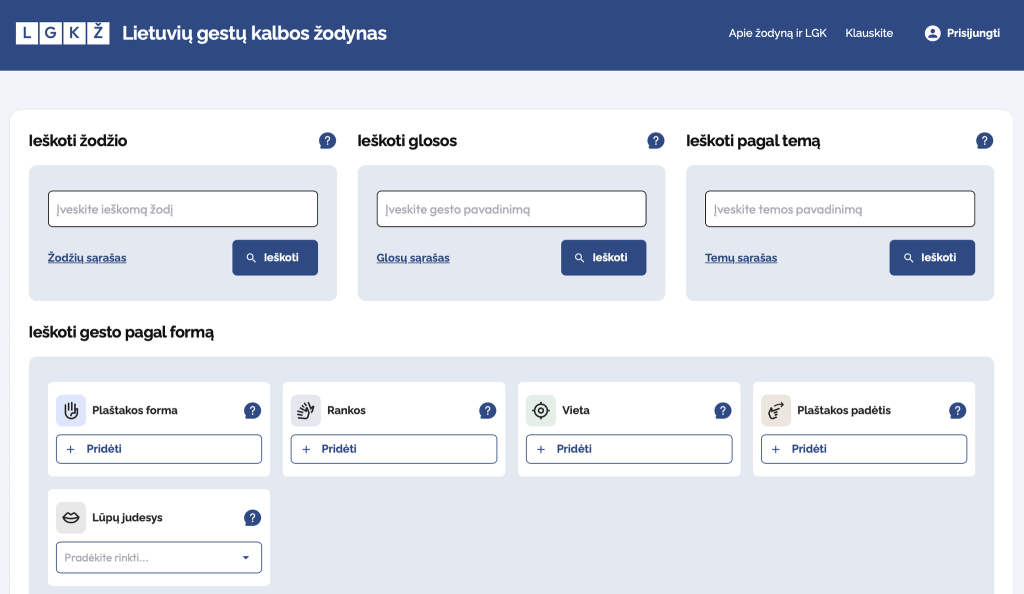
The dictionary is being updated as part of the European Union-funded project “Enhancing the Competencies of Sign Language Professionals.” The improvements to the digital dictionary are immediately apparent. On the homepage, users can now see not only search fields but also the most popular and recently added signs, as well as an option to browse signs alphabetically by gloss. These features encourage users to explore the dictionary and discover new signs.
The modern digital dictionary allows users to search for signs by Lithuanian words, topics, and five phonological parameters: handshape, orientation, location, movement, and non-manual features, specifically mouth movements. Although these search options were available previously, the search process is now more convenient, while searching by sign form has become simpler and more intuitive. A new feature allows users to search for signs by glosses, which are conventional labels assigned to signs.
The illustrations used for searching by sign form have also been updated. When searching for a Lithuanian word, users are presented with its various forms and examples of its use in sentences, helping them understand different meanings of signs and how they are used in context. Sign videos now play automatically and loop continuously, while search results display videos instead of the photographs used previously. By hovering over a search result, users can immediately preview the sign without opening a separate entry. This makes finding the desired sign faster and more convenient.
The dictionary update also aims to ensure greater consistency in the presentation of sign variants. When a sign has several variants, they are identified using special markers, with the recommended variant displayed first. The updated dictionary also introduces personal user accounts, allowing users to view their browsing history and access saved favourite signs or sentences.
As the project is still ongoing, further improvements to the dictionary are underway. One of the planned features is the introduction of transcriptions of sign language interpretation sentences, which will become available at a later stage.
This resource is valuable not only to Lithuanian Sign Language users but also to learners, educators, sign language interpreters, and anyone interested in gaining a deeper understanding of Lithuanian Sign Language. The dictionary update also contributes to strengthening inclusive education in Lithuania by providing better opportunities to learn and use Lithuanian Sign Language in educational settings.
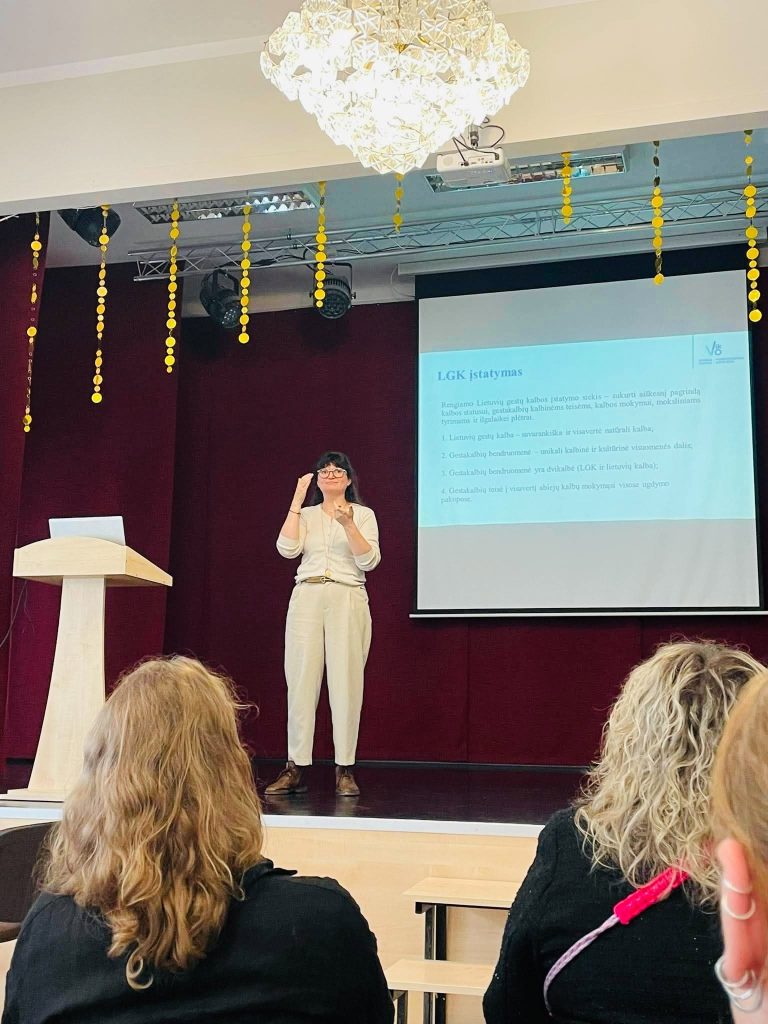
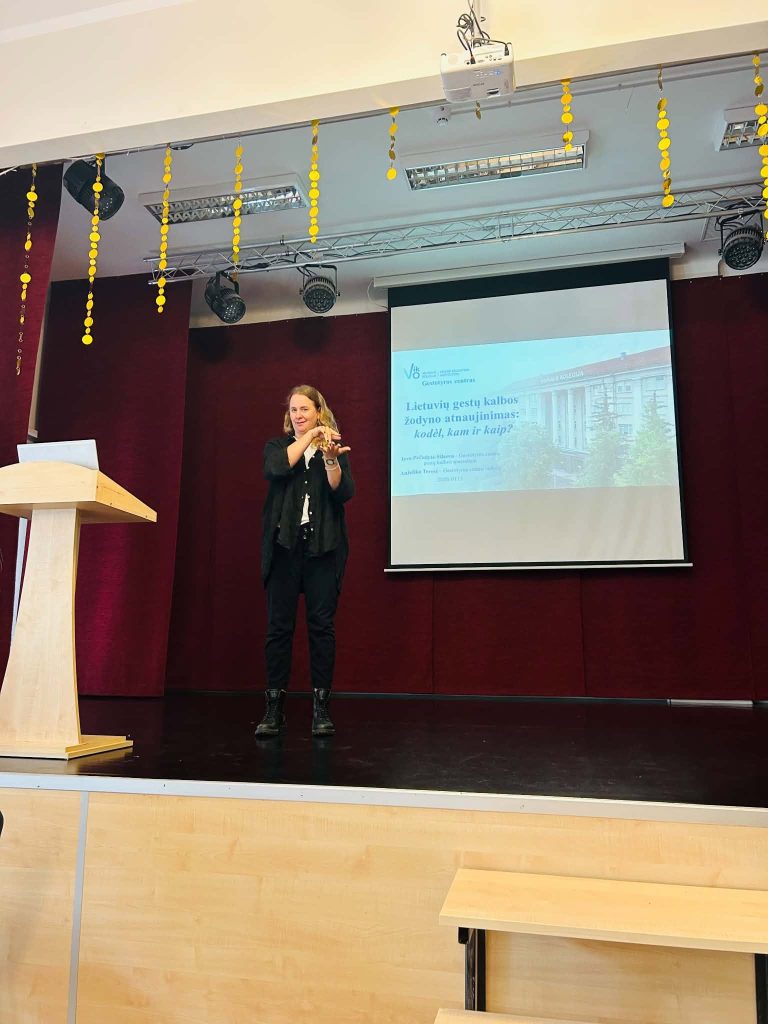
On 15 October, the updated dictionary was presented at the event “Education of Deaf and Hard-of-Hearing Students: From Strengthening Competencies to Practical Solutions,” held at the Lithuanian Centre for the Education of the Deaf and Hard of Hearing (LKNUC). The event was organised by the Centre’s Sign Language Promotion and Teaching Department. During the event, new professional development resources and teaching materials for educators and educational support specialists were introduced.
During the event, Anželika Teresė, Head of the Sign Language Research Centre, opened the dictionary presentation by posing a fundamental question: why do we talk about Lithuanian Sign Language, and why is it important to me? Lithuanian Sign Language specialist Ieva Pečiulytė-Silaeva then delivered a presentation entitled “Updating the Lithuanian Sign Language Dictionary: Why, for Whom, and How?” and introduced the new dictionary to the event participants.
Although the updated Lithuanian Sign Language Dictionary is already publicly available, work on its further development continues. As part of the ongoing project, the dictionary will continue to be expanded and refined to ensure its quality and meet users’ needs.
The updated Lithuanian Sign Language Dictionary is available at: www.lgkz.lt .